Nautical Watercolor Clipart: A Practical Guide to Usage, Quality, and Design Fit
When curating visual assets for creative projects, the choice of style often dictates the emotional resonance of the final product. Nautical watercolor clipart has emerged as a distinct category within digital design resources, offering a blend of maritime tradition and artistic softness. For designers, scrapbookers, and small business owners, understanding the specific utility of this asset type is crucial. Unlike rigid vector illustrations or high-contrast photographs, watercolor elements introduce texture, fluidity, and a sense of hand-crafted authenticity that can elevate simple layouts into cohesive narratives.
The core appeal of nautical watercolor clipart lies in its ability to soften the often harsh lines associated with traditional maritime themes. While anchors, ships, and lighthouses are classic symbols, rendering them in watercolor transforms them from industrial icons into decorative art. This transformation makes the graphics particularly versatile for applications ranging from wedding invitations to educational materials. However, selecting the right resource requires evaluating resolution, file format, and stylistic compatibility against project requirements.
Defining the Distinctive Qualities of Watercolor Maritime Art
To evaluate whether nautical watercolor clipart is the right choice, one must first understand what separates it from other graphic styles. The defining characteristic is the simulation of pigment interacting with paper. In digital formats, this is achieved through layered transparency and edge variation, mimicking the way real watercolor paint bleeds and dries. This creates a visual depth that flat colors cannot replicate.
When compared to solid-color vector clipart, watercolor images offer a more organic feel. Vector graphics are mathematically defined, resulting in crisp, clean edges that scale infinitely without quality loss. While vectors are excellent for logos and technical diagrams, they can sometimes appear sterile when used for personal or celebratory items like greeting cards or party supplies. Nautical watercolor clipart bridges this gap by providing scalable digital convenience while retaining the warmth of traditional media.
Furthermore, the color palette inherent to this style is typically softer than standard commercial clipart. Blues, teals, sandy beiges, and muted whites dominate, creating a harmonious aesthetic that fits well with coastal, vintage, or shabby-chic themes. This natural cohesion reduces the need for extensive color correction during the design process, saving time for creators who need to produce multiple variations of a single project.
Technical Specifications: Resolution and File Formats
A critical factor in choosing digital assets is the technical specification, specifically regarding resolution and background handling. For professional-grade output, particularly in print, the resolution of the image is paramount. High-resolution (hi-res) graphics, typically defined as 300 DPI (dots per inch), ensure that details remain sharp when printed on physical media. Lower resolution images, often found in free or low-cost stock libraries, may appear pixelated or blurry when enlarged for wall art or large-format invitations.
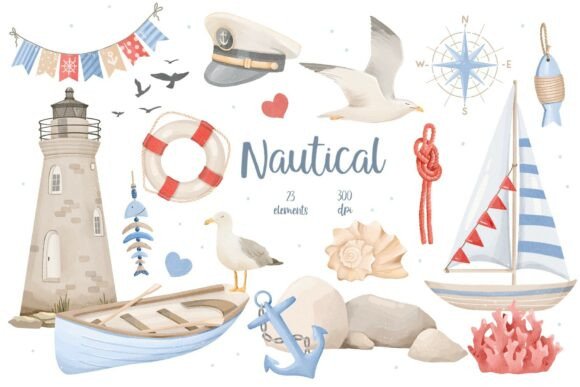
The inclusion of 23 PNG images with transparent backgrounds in a comprehensive set addresses a common pain point in digital design. The PNG format supports alpha channels, allowing the background to be removed entirely. This means the nautical elements—whether a compass rose or a sailing ship—can be placed over any colored background or photograph without an unsightly white box surrounding them. This flexibility is essential for digital scrapbooking, where layers of photos, textures, and text must integrate seamlessly.
Compatibility across software platforms is another decisive factor. A robust collection should function within all major programs, including Adobe Photoshop, Microsoft Word, GIMP, and various online design tools. The versatility of these files allows users to work within their preferred ecosystem without needing specialized conversion software. Whether a user is designing a complex layout in Photoshop or creating a quick label in Word, the high-quality PNGs maintain their integrity, ensuring consistency across different devices and applications.
Comparing Alternatives: Vectors, Photos, and Hand-Drawn Scans
While nautical watercolor clipart offers significant advantages, it is not the only option available for maritime-themed projects. Understanding the tradeoffs between this style and alternatives helps in making an informed decision.
- Vectors vs. Watercolor: As mentioned, vectors provide infinite scalability but lack texture. If a project requires bold, graphic statements or needs to be resized to billboard dimensions, vectors are superior. However, for intimate items like gift tags or stationery, the softness of watercolor is often more appropriate.
- Photographs vs. Illustrations: Using actual photographs of the ocean or ships can ground a design in reality. Yet, integrating realistic photos with text and other graphic elements can be challenging due to lighting and color mismatches. Watercolor illustrations act as a neutral bridge, blending easily with typography and other design elements without clashing.
- Hand-Drawn Scans vs. Digital Sets: Some creators scan their own physical paintings. While unique, these scans can vary in quality and often have inconsistent lighting or background noise. A curated set of digital watercolor clipart ensures uniform quality and consistent style across all 23 images, which is vital for maintaining a professional look in a series of designs.
For many users, the "middle ground" offered by digital watercolor sets provides the best balance of aesthetic appeal and technical reliability. It avoids the rigidity of vectors and the unpredictability of raw photography, offering a polished look that feels personal yet professional.
Ideal Use Cases and Application Strategies
The versatility of high-resolution nautical watercolor clipart extends across a wide range of practical applications. Because the images feature transparent backgrounds and high DPI, they are suitable for both digital distribution and physical printing.
Digital Scrapbooking and Invitations: In digital scrapbooking, layering is key. These graphics serve as perfect focal points or accents. Their soft edges allow them to sit naturally atop photographs of family vacations or beach weddings. Similarly, for invitations, the watercolor style conveys elegance and thoughtfulness, setting a tone that is welcoming rather than formal.
Wall Art and Home Decor: When printed at 300 DPI, these images retain enough detail to create stunning wall art. A collection of nautical elements can be arranged into a gallery wall or combined into a single composition. The watercolor aesthetic complements various interior design styles, from modern coastal to rustic farmhouse, adding a touch of artistic flair without overwhelming the space.
Commercial and Small Business Uses: For entrepreneurs selling party supplies, labels, or greeting cards, having a cohesive set of 23 images allows for rapid prototyping and production. The ability to use the same assets for web sites, social media graphics, and printed products ensures brand consistency. Gift tags and labels benefit significantly from the transparent background, as they can be printed on colored cardstock without obscuring the underlying material.
Evaluating Limitations and Decision Factors
Despite their strengths, nautical watercolor clipart is not universally applicable. There are scenarios where other styles may yield better results. For instance, if a design requires extreme precision, such as a technical diagram of a ship's hull or a logo that must be legible at very small sizes, the soft edges of watercolor may hinder readability. In these cases, line art or vector graphics are the superior choice.
Additionally, the color palette of watercolor sets is often pre-determined. While this ensures harmony, it may limit customization for brands with strict color guidelines. Users may find themselves needing to adjust hues or saturation levels in post-production to match specific brand identities. While tools like Photoshop and GIMP allow for these adjustments, it adds a step to the workflow that might not be necessary with more neutral vector assets.
Another consideration is the file size. High-resolution PNGs with transparency can be larger in file size compared to simple vectors or JPEGs. For web optimization, this may require compression to ensure fast loading times on websites. However, for print purposes, this higher file size is a necessary tradeoff for quality.
Making the Right Choice for Your Project
Ultimately, the decision to use nautical watercolor clipart depends on the desired outcome of the project. If the goal is to evoke a sense of nostalgia, romance, or artistic charm, this style is an excellent fit. The combination of high resolution, transparent backgrounds, and broad software compatibility makes it a powerful tool for creators looking to produce professional-quality work without starting from scratch.
For those comparing options, consider the end medium. If the primary output is print—such as invitations, cards, or wall art—the 300 DPI quality of these graphics is non-negotiable. If the project is strictly digital and requires minimal file size, a lower-resolution alternative might suffice, though it risks compromising visual fidelity. By weighing these factors, designers can select resources that align with their specific needs, ensuring that the final product is both visually appealing and technically sound.
In the landscape of digital design resources, nautical watercolor clipart occupies a unique niche. It offers the best of both worlds: the ease of digital manipulation and the soulful texture of traditional art. Whether used for personal memories or commercial ventures, these assets provide a reliable foundation for creating meaningful and aesthetically pleasing designs.